The Kitchen Is Not a Room: Why Most Fail
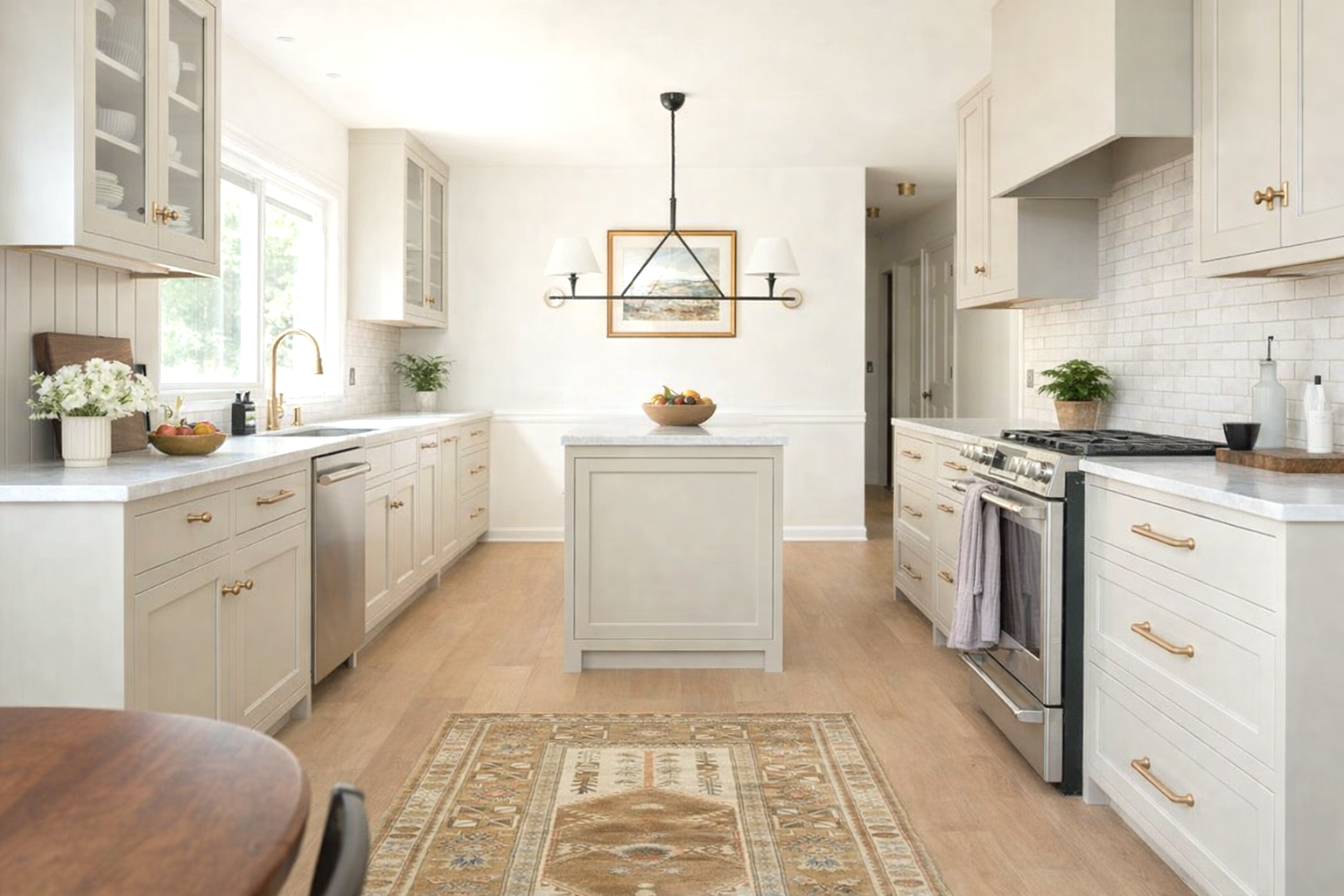
A Process of Parts
The contemporary kitchen is rarely conceived as a room in its own right. More often, it is approached as a sequence of selections—cabinetry, worktop, hardware, lighting—each considered independently, each resolved in isolation. The process feels methodical and, on the surface, thorough. Every component is weighed, compared, and ultimately chosen with care. And yet, when assembled, the result frequently lacks conviction. It feels unsettled, not because any single element is incorrect, but because no relationship has been established between them.
This is the quiet failure at the center of most kitchens: they are constructed, but never composed.
An Arrangement of Relationships
A kitchen, properly understood, is not a collection of objects but an arrangement of forces. Surface meets light, mass is set against void, and warmth is introduced only where it can be sustained. These are not decorative concerns but structural ones, and they determine whether a room holds together or quietly dissolves into parts. One does not experience a cabinet or a slab of stone in isolation; each is read in context, its presence defined by what surrounds it and, equally, by what has been deliberately withheld.
Without this underlying order, even the most carefully sourced materials struggle to assert themselves. They remain curiously inert, unable to form a coherent whole.
The Wrong Question
Most kitchens fail before they begin because the question at their foundation is misplaced. The process typically starts with what—what cabinetry, what stone, what finish—when it should begin with how. How the room is meant to be read, how it is to be occupied, and where its center of gravity lies. Without answers to these, the subsequent decisions, however refined, lack direction. They accumulate rather than align.
Why Improvement Falls Short
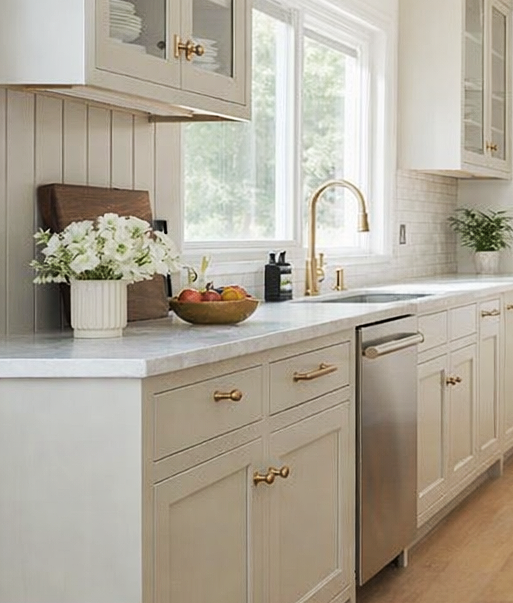
It is for this reason that improvement so often fails to resolve a kitchen. Replacing hardware, repainting cabinetry, or introducing new lighting may refine the individual elements, but it does little to address the condition that made the room feel unresolved in the first place. The system remains intact, and the same tensions—between competing materials, between equal visual weights, between elements that neither lead nor recede—persist beneath the surface.
Improvement, in this context, becomes a more polished version of the same problem.
A More Disciplined Way of Seeing
A more rigorous way of looking is required. Where the untrained eye moves across a kitchen noting finishes, the practiced eye reads structure: alignment, proportion, and the distribution of visual weight. It asks where the eye is drawn upon entering the room, what sustains that attention, and what disrupts it. These are not abstract considerations but the basis of coherence.
Two kitchens may share the same materials and yet arrive at entirely different outcomes; in one, the elements are held in quiet balance, while in the other they remain loosely assembled, never quite settling into place. The distinction lies not in taste, but in composition.
Authorship and Restraint
To approach a kitchen as a room, rather than a set of decisions, is to accept a certain degree of authorship. It requires the establishment of a central idea—something that determines what the room is allowed to become and, just as importantly, what it is not. From this, a hierarchy emerges: one element assumes prominence, others support, and the remainder recede into the background.
The room begins to organise itself, not through accumulation, but through restraint.
A Kitchen, Resolved
A well-composed kitchen does not announce the decisions behind it. It does not rely on novelty or excess to hold attention. Instead, it achieves a quieter effect: a sense that everything is where it should be, and that nothing could be easily removed or replaced without consequence. Such rooms are rarely the result of better choices alone, but of a clearer intent carried consistently from the first decision to the last.
Until that shift occurs, the kitchen remains what it too often is—capable, even attractive, but never fully at rest.